

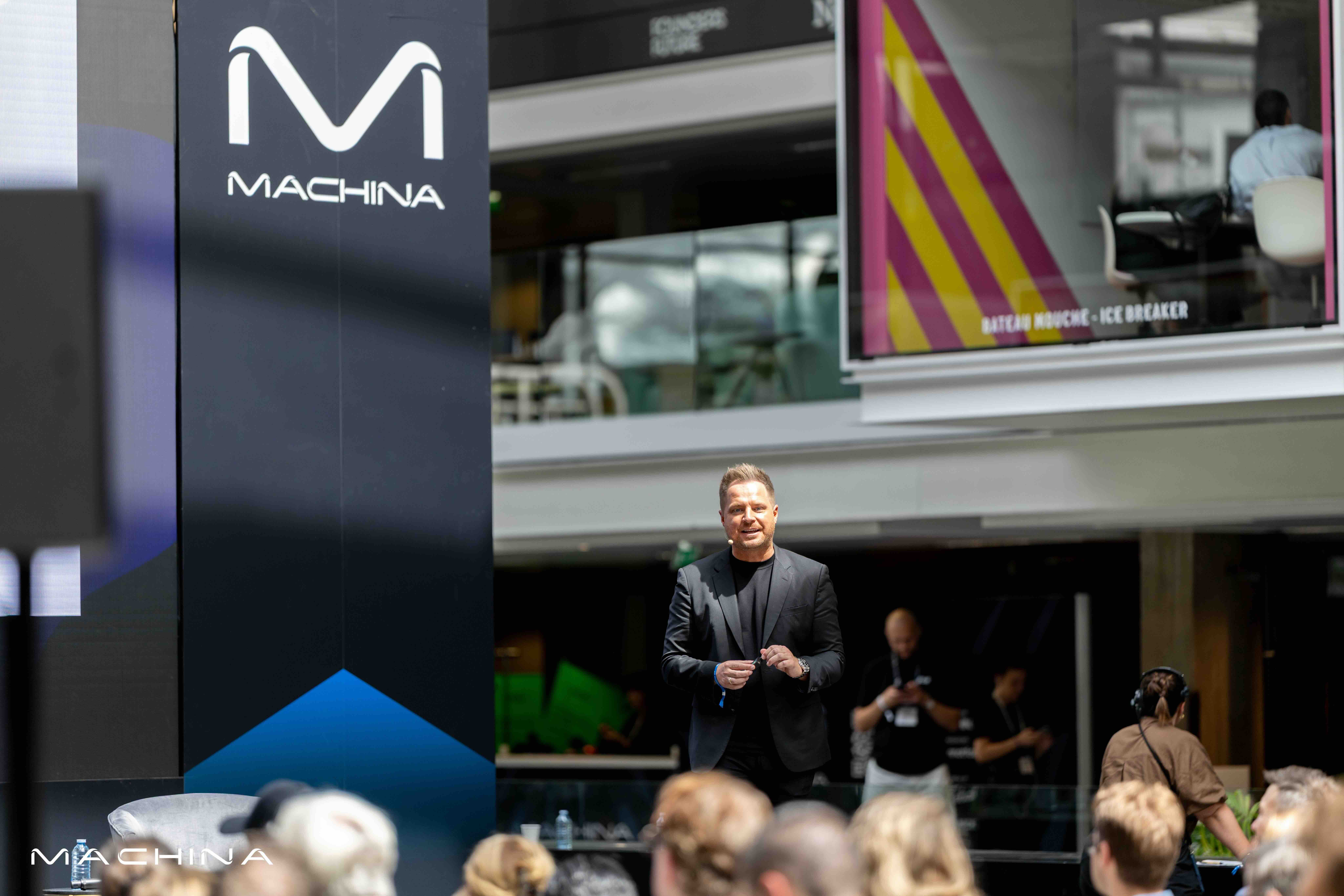
A few days ago, I sat down in Évian with leading business figures from France and Germany. President Macron was there too, and one question kept coming up in our conversations: What does Europe need to do to lead in AI and robotics?
My answer was the same one I have given since founding NEURA Robotics in 2019: Europe must recognise its strengths, connect them, create a market of its own and act much faster. The next wave of AI, Physical AI, is Europe’s great opportunity because it depends on a whole range of industrial capabilities that are well established across the European Union. We now need to bring these fragments together into a system. Then we won’t have to import Physical AI from other parts of the world. We can develop it here, on our own terms and in line with our values.
The next wave of AI gets a body
The first wave of artificial intelligence taught machines to understand and generate language, and with it information. They write, speak and see. European companies such as Mistral, which are developing powerful models of their own, are essential if we want to achieve technological sovereignty in this field.
But the international race for the next phase has already begun: intelligence is leaving the screen and starting to act in the physical world. Autonomous machines lift loads in factories, move goods through warehouses, support care workers or help on farms. Soon they will become as familiar in our homes as the personal computer once did. AI will enable machines to perceive and understand any environment we can think of, and to move through it autonomously. As these Physical AI systems connect, they will bring productivity gains across society on a scale we can’t really imagine yet.
Physical AI is an integrated system.
At the same time, Physical AI is changing the structure of global competition. Computing power and software platforms remain crucial, but they are no longer enough on their own. What matters is bringing together sensors, mechanics, microchips, energy, data, models and manufacturing that can scale. And that takes capital too. Only by bringing all these disciplines together can we ensure that the resulting Physical AI systems work reliably and can be trusted.
Europe has the parts. Others are building systems.
The United States has shown how to build platforms and create entire markets in the digital world. China is showing how industrial ecosystems can be built from the ground up at enormous scale. Meanwhile, Europe has become a niche specialist and a user of other people’s systems. That’s a pointed way of putting it, but it does reflect the public debate about economic strength and sovereignty.
Because Physical AI depends on all these capabilities, the race won’t be won by the best model, chip or robot alone. What matters is who can bring them together into a system that can scale, much as carmakers and their supplier networks have done over the past decades.
The automotive industry shows that Europe has this ability, and the industrial substance to back it up. What we lack is a shared goal: to turn our many individual strengths into one system.
France combines a predominantly low-carbon power supply with computing infrastructure, a growing AI ecosystem and a strong aerospace industry. Germany and Austria contribute their expertise in mechanical engineering, robotics and automation, as well as mechatronics, sensors, drive technology and precision gearboxes. With its EUV lithography systems, the Netherlands has a key technology for the most advanced semiconductors, while Belgium complements this with leading semiconductor research. Spain and Italy bring strengths in highly automated series production, machine tools and industrial production systems, while Denmark contributes its expertise in collaborative robotics. Poland has significant capacity in battery and electronics production and the industrial base to manufacture in large volumes. And even this is only part of what Europe could bring together.
The know-how built up over many years by countless companies, large and small, comes together with an excellent, well-resourced research and education sector.
From what I see, Europe has the strongest foundation for taking the global lead in Physical AI. But it is spread across countries, industries, strategies and funding programmes. At the same time, some gaps remain: important high-performance chips come from outside Europe, key cloud platforms are controlled elsewhere, and scale-ups often lack growth capital. Yet we don’t fundamentally lack money or technical capability. We just rarely bring the two together quickly enough.
We are not running out of work. We are running out of people.
For Europe, Physical AI is more than an opportunity. It is a necessity. Our population is ageing while the share of people of working age is shrinking. Even so, we want to preserve our prosperity, healthcare, pensions and quality of life. But we can’t do that by simply expecting fewer and fewer people to carry more and more of the burden.
Education, retraining, migration, better working conditions and good incentives to work remain essential. Yet even with all of these, staff shortages will grow in dangerous, monotonous and physically exhausting jobs. That’s why we need intelligent machines to lift loads, move materials and take over routine work. If this gives people more time for responsibility, creativity and caring for others, Physical AI will be a key answer to Europe’s demographic challenge.
Without European customers there will be no European champions
There is a simple lesson we can take from the first wave of AI, the large language models: it isn’t enough for Europe to produce ideas. Basic research and excellent technology alone do not create economic and technological sovereignty. Even if promising start-ups emerge, their technology only becomes globally relevant when it can be used at industrial scale.
Europe must not invest billions in AI, robotics and semiconductors, only to buy the resulting products for millions of people from elsewhere. If European taxpayers fund innovation, European companies must also have a fair chance to put their technology to work in our factories, infrastructure and public projects. To get this started, we can create shared testing environments, provide reliable first orders and make strategic use of procurement.
Of course, this must not become a sheltered market for mediocre products. Europe will only be strong with open interfaces, real competition and global cooperation. But openness can no longer mean that we pay to develop technologies and then leave it to others to scale them.
Europe’s industry can become the training ground for robotics.
Once the ball is rolling, the system begins to sustain its own momentum. Every real-world use of Physical AI generates valuable data from experience in the physical world. A robot can’t find the equivalent of what ChatGPT learned from the internet, because it needs to learn what an unfamiliar object feels like, how much force a material can take or what actually happens when something goes wrong. With its high standards and industrial diversity, European industry has a unique opportunity to become a training ground and a source of skills for the next generation of robotics around the world.
European strengths need a common starting point
France and Germany can make a start. After all, somebody has to. And then the rest of Europe can join in.
Twenty people. Ninety days.
So here is my concrete proposal: give us twenty people from AI, robotics, semiconductors, energy, industry, infrastructure and finance. Put them in one room for ninety days and ask them to design a shared Physical AI infrastructure and prepare a few industrial pilot projects that can start straight away.
Of course, this group would replace neither democratic decision-making nor a European strategy. But it could help us move beyond declarations of intent, start building and show what is possible.
The race has only just begun
When I founded NEURA seven years ago, we didn’t have everything we needed to realise our vision. We had a team of about twenty people, a clear goal and the determination to build the first cognitive robot that people could actually buy. I’ve always believed that you have to get started, even when not everything is clear or in place yet.
The starting gun in the race for Physical AI has only just sounded. It is still far from decided who will shape the system, the market and the standards. So let’s not declare ourselves defeated already.
Let’s bring our strengths together, create a market and get the first shared projects started. Now.
“`